

Carrow Abbey
Location
Bracondale, Norwich, NR1 2DD
About
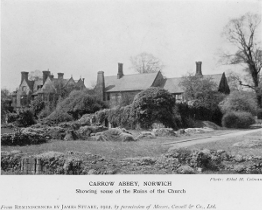
The site of Carrow Abbey consists of the ruins of a 12th-century Benedictine nunnery and the surviving late medieval Prioress' House. In 1146, following a grant of land from King Stephen, nuns Seyna and Lescelina, who were also sisters, founded a priory on the site. They seem to have built a vast priory church with extensive monastic buildings.

A significant portion of the remains of the monastic complex is still visible above ground. The remains of the church include sections of the external walls of the nave, the south transept and the east end. Remains of the monastery are largely confined to the vestiges of the east range that included the chapter house and the nuns' living quarters. The only building still standing—the Prioress' House—was built in the early 16th century by Isabel Wygan, the penultimate prioress.
The house survived in use as private accommodation until it was bought by Jeremiah James Colman in 1878. After the purchase, it was restored by architect Edward Boardman over the next eight years. Jeremiah James' 1880 excavation of the site exposed most of the abbey's remains which are visible today.
More information
Read the historical essay 'Houses of Benedictine nuns: The priory of Carrow' by William Page, 1906.
The Colman's map webpages
The Colman's map webpages list
-
-
-
![]()
Carrow Abbey
See more (Go to Carrow Abbey) -
-
-
-
-
-
-
-
-
-


