

Advertising and children
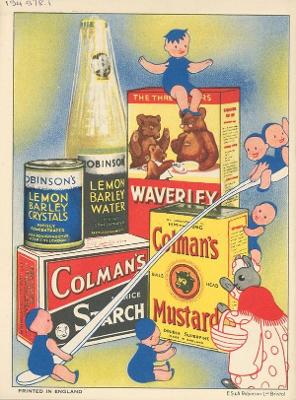
Colman's realised early on the potential of targeting their publicity materials at children. Children's love of visual media and collecting made them ideal recipients of promotional materials: they looked after them, reused them and swapped them. There were three principal routes through which Colman's advertising reached children: as collectible merchandise as gifts, and at school.

At the turn of the 20th century Colman's began to distribute educational wall charts and display cases to schools willing to receive them. The cabinets contained samples of Colman's key products, a selection of raw materials and side products at various stages of manufacture, and examples of packaged products in miniature.

Colman's also supplied schools with well-made and well-illustrated educational wall charts. The topics tended to be botanical or zoological—for example, presenting sequences of British birds, fish or prehistoric animals and plants. The illustrations were drawn by lithographic artist George Fowler, using specimens from the British Museum and the Zoological Gardens (now the London Zoo). Most of the wall charts achieved their advertising purpose in a subtle way: by spelling names of products discreetly using letters placed beside the images of animals and plants.
Illustrated booklets for children
Illustrated children's booklets were some of the most charming and sustained forms of advertising by Colman's. The booklets' visual attractiveness and artistic value combined with their recipients' tendency to cherish such things, made the booklets effective and long-standing reminders of Colman's and its products. The booklets were often kept for a lifetime and sometimes the pages were stuck up on nursery walls. The production and distribution of booklets annually at Christmas continued for eight decades, from the 1880s to the 1950s. Charles Clowes, of the Colman's advertising department, oversaw the production of booklets during the first 20 years, commissioning top illustrators and ensuring high quality colour reproductions. Up to a million copies were printed and distributed free of charge every year, many of them to the children of the workers at Carrow.

Pure advertising in the booklets was restricted to the back and inner pages of the cover. This subtle approach remained in place until at least 1914. The subjects of the booklets included takes on fairy stories and nursery tales (Joan and the Pixies, Puss in Boots) and interpretations of excerpts from fiction, including Charles Dickens' The Pickwick Papers and Jonathan Swift's Gulliver's Travels. Titles like Miss Bounce and India Rubber Jack used the aesthetics of comic books, while instructive booklets taught how to take care of pets or encouraged the study of nature.

Some of the most artistically accomplished booklets were the early examples, such as John Hassall's The Foolish Little Frog and Alice B. Woodward's Mr Pickwick on the Ice or The Jackdaw of Rheims. The imagination and stylistic diversity of the commissions dwindled after 1918. The booklets produced immediately after the First World War took a darker and more politicised tone: in the 1919 booklet 'The Wonder', two children are shown the defeated German Kaiser Wilhem II amidst the ravages of war.

The booklets from the 1920s,1930s, and later tended to promote characters and storylines associated with Colman's products, such as the adventures of the Three Mustardeers and 'The Magic Mustard Pot'. Despite the gradual changes in approach to storytelling and illustration, the Colman's booklets for children remain one of the greatest achievements of the firm's advertising history, as well as a major—and moving—contribution to the history of advertising as a whole.
The conceited Christmas pudding advertising booklet
The conceited Christmas pudding was an advertising story booklet for children.
Related webpages

Advertising in transit

Posters and enamel signs


