

Advertising in transit
Advertising by rail
Before the arrival of the railways to Norfolk, carts were the primary means of transporting goods to customers, both locally and as far afield as London. The opening of the Swainsthorpe railway station in 1845 created a whole new range of possibilities for Colman's, which was then operating the factory at Stoke. The 1850 purchase of land with its own railway siding at Carrow—a transaction which initiated the company's move to Norwich—meant that Colman's could begin to build an internal railway system which connected to the fast-growing network of national railways.

Rail transport quickly became the primary means of moving raw goods in, and product out, of the Carrow Works. In 1880, close to a million casks and boxes were sent by rail out of the Works. The same year saw close to 12,000 loaded railway wagons moving goods in and out. The rate of traffic only increased over the years: by 1933, goods coming out of the works alone required as many as 9,700 wagons.

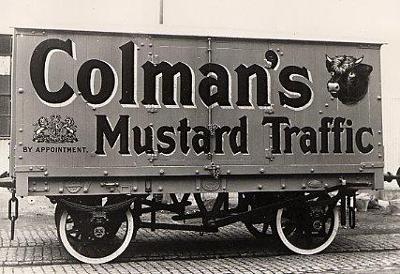
Railways provided a brilliant opportunity for Colman's advertising. As the company began to need more railway wagons than the railway company could supply, Colman's was allowed to use its own rolling stock. The company had to comply with strict rules set out by the Railway & Canal Traffic Act, which allowed only simple text to be displayed on vehicles as a means of advertising. This was not much of a limitation for Colman's, a company with already well-developed brand visuals—including the striking colour scheme, bold lettering and recognisable brand logo. Colman's mustard-yellow wagons bearing simple lettering in red and black carried the name and fame of the brand far and wide. The simple messaging included 'COLMAN'S MUSTARD TRAFFIC' and 'COLMAN'S STARCH TRAFFIC'. Even coal transports were conspicuously labelled as the 'COAL FOR COLMAN'S MUSTARD WORKS'. Meanwhile, the inconspicuous railway company wagons carrying Colman's goods were appropriately fitted with Colman's advertising banners.

Water transport and the 'Mustard Pot' steam tug
Carrow Works' extensive waterfront and access to the navigable River Wensum meant that goods transport by water was immensely important until the Second World War. Goods—mainly those destined for export—were carried down the Rivers Wensum and Yare to the depot at Great Yarmouth. Goods then continued down to London and the ships in the London docks. Colman's had its own Jubilee Wharf at Wapping, which received raw goods for transport to Norwich.
We have a record of one water vehicle that must have been a novel sight on the River Yare: in 1924 the company purchased a powerful steam tug, which was christened 'Mustard Pot' and had two brass mustard pots flanking its funnel. The Colman's tug ended its days somewhere in Africa, after it was commandeered and sent there by the Admiralty during the Second World War.
Advertising on the road
A limited number of road vehicles was used by Colman's for mainly local deliveries. These vehicles had a smaller geographical range and cargo capacity in comparison to rail wagons, but their advantage was a lack of restrictions on advertising. Colman's horse-drawn carts were particularly eloquent in their use of livery and advertising messages. The carts were eye-catching and decorative, and even won prizes at local shows and parades.

One survival is a particularly flamboyant echo of such advertising vehicles: the Colman's omnibus is a horse-drawn London passenger omnibus, which was built in 1885 and used on the King's Cross route until the First World War. After five decades serving as a pig food store, the omnibus was rebuilt and restored in 1974 and used for sightseeing tours in London. Colman's purchased it in 1977, fitted it with enamel advertising signs and used it for promotion at events such as the Lord Mayor's Procession in Norwich and the Royal Norfolk Show.

Related webpages

Posters and enamel signs

Advertising campaigns and film


