

Posters and enamel signs
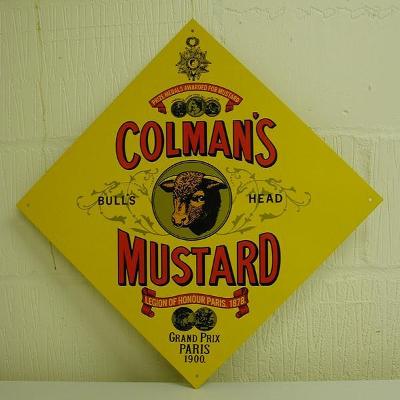
Newspaper advertising, posters, show cards and iron plates had made the name Colman almost synonymous with the name Mustard.
- Thomas Russell, 1923
By the late 19th century, the typical text-rich Victorian poster was replaced by posters with eye-catching artwork and succinct, direct and suggestive catchphrases. Posters were a form of mass communication which carried humorous content particularly well. Colman's early posters combined the latest trends in art and design with subtle humour. The most famous posters for Colman's included Cecil Aldin's 'blue peasant' poster for Colman's starch and John Hassall's 'Mustard Girl' and two Klondyke posters. Aldin and Hassall's techniques, combining simplicity and firmness of line with block-like areas of unmodulated colour, resulted in memorable and visually arresting compositions, which were perfect for poster images. These posters remain iconic examples of early advertising.

The enamel sign was a more durable and, due to the brightness of its colours, more eye-catching form of advertising poster. Enamel signs tended to blend better with their surroundings, perhaps because of their appearance of permanence. They were therefore less intrusive and did not contribute as much to the visual 'litter' that posters and other more ephemeral forms of advertising could create. In the case of Colman's, the saturated colour palette (especially the mustard yellow) was made even more striking by the glossy finish of the enamels.

Enamels advertising Colman's mustard and starch decorated the exteriors of post offices and tobacconists, railway station walls and interiors of rail carriages. The signs, which generally bore simple messages and imagery, were either commissioned externally (from the Patent Enamel Company Ltd., the pioneers of advertising enamels) or produced at Carrow (the printing department was originally set up to produce enamel signs). Colours and designs were lithographed onto special transfers which were then baked onto metal plate in temperatures reaching 800°C. Bright, clear and extremely durable, enamel signs went on to advertise Colman's products for decades. Some can still be spotted in their original surroundings, but most have become museum objects or collectors' items.

Related webpages

Advertising campaigns and film

Advertising and children


