

Advertising campaigns and film
If you have an old, established article to advertise, do not be content with seeking new buyers. Seek new uses for the article.
Such was the underlying attitude when it came to Colman's advertising its perhaps unexciting but established and trusted products. New uses were found for mustard, including mustard plasters (sinapisms), bath mustard and poultry mustard.

A big part of Colman's advertising strategy was the employment of medical and scientific testimonials and claims. Advertising bills, posters and product packaging reminded the public that mustard improved health by aiding digestion and raising stamina. Colman's publicity also promised that mustard powder added to a hot bath had the power to relax and revive the body and even cure colds! The sporadic newspaper and magazine advertising generally aimed to associate the products, especially mustard, with an idea of luxury and sophistication. An example of this is the newspaper advert 'After the dance a Mustard bath' from 1920.

The Mustard Club
The Mustard Club was Colman's most notable and original advertising campaign. It was the brainchild of Oswald Greene, of the advertising firm S.H. Benson's. The campaign appealed to British consumers' sense of humour and reached them via virtually every available medium.
The Mustard Club's launch was shrouded in mystery: in September 1926 cryptic and intriguing messages began to appear on London buses. Slogans such as 'Has Father joined the Mustard Club' or 'Blackballed from the Mustard Club' sparked debate in the press. The next stage of the campaign followed several weeks later, when the board of directors of the Mustard Club was introduced, and investors invited to buy shares. Potential investors who thought the club was real and did not see through the imaginary directors' names (including Baron de Beef and Master Mustard!) were asked to 'write indistinctly' on the application. The press asked 'What IS the Mustard Club?'. Meanwhile, the prospectus advertising the new venture openly praised the medicinal, culinary and even social benefits of freshly prepared mustard, and the Club's registered address was 108 Cannon Street—the London offices of J. & J. Colman.

The suspense was resolved on 29 October 1926, when Benson's took out an advertisement on the entire front page of the Daily Mail, explaining the 'Aims, Objects and Rules of the Mustard Club'. The Daily Mail had a circulation of 1,750,000, so the move contributed significantly to the public's fascination with the Mustard Club. The London and Norwich Colman's offices were flooded with applications for membership of the non-existent club.
The characters of the officers of the club were drawn by artist John Gilroy, who was employed by Benson's at the time. These images were distributed and made familiar to the public through newspaper advertisements, leaflets, films, recipe books and even a card game drawn by Gilroy. Each of the characters promoted a slightly different use of mustard 'in the fine old tradition of good cheer'.

The club's catchphrase, 'Pass the mustard', was used in ventures in which a local newspaper would advertise a visit to town from a mystery diner. Every waiter or waitress who passed the mustard to the diner (who was usually member of the Colman's advertising department) would be handed £1.
In the following years the campaign employed other writers, including crime novelist Dorothy L. Sayers, who wrote copy for numerous promotional materials. After the closure of the campaign in 1933, Sayers used it as inspiration for her book Murder Must Advertise.

While the hugely popular and expensive campaign was unlikely to increase sales of mustard in the long run, it certainly helped to make Colman's synonymous with mustard. As Oswald Greene wrote, 'For the first time in history, about 98 people in every hundred have been talking about mustard'.8 The Mustard Club put mustard on everyone's lips.

Film
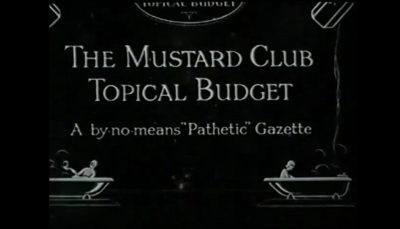
A rare and significant collection of Colman's advertising films for cinemas survive from the 1920s and 1930s. At least two of the films advertised Colman's Mustard Club: 'The order of the Bath', which inventively incorporated humour and fantasy, and 'The Mustard Club Topical Budget', which emulated the style of the cinema newsreels of the day.

Early animated films advertised Colman's starch, again using humour to increase the appeal of what was a very commonplace product. Humour continued to be a founding principle of Colman's film advertising for most of the 20th century.
Related webpages

Advertising and children

Advertising in transit


