

Work
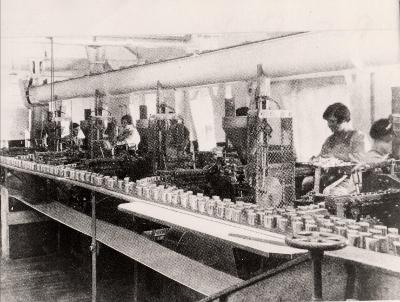
The textile industry was a major employer in pre-industrial Norwich. By the late seventeenth century, the industry employed some 72,000 people in the city. By the first half of the nineteenth century, however, the industry became destabilised and deskilled. The fashion for lighter, cheaper fabrics which were easier to produce also meant that manufacturers began to rely on cheap female and child labour. By 1840 over 1,000 out of the more than 5,000 looms in the city were not in use; of the remaining 4,000 or so, almost half were operated by women and children. Complex geopolitical and social changes created an influx of people seeking work, which added to the already crowded labour market.

The J. &. J. Colman's move into Norwich in the 1850s could not have been better timed for the company. The King Street and Lakenham areas surrounding the new Carrow Works were crowded with the unemployed, both skilled and unskilled. Jeremiah James Colman 'saw in the unemployed handloom weavers a pool of readily available, skilled labour that would enable him to expand the business.' With further social changes brewing in the second half of the century, things were only to get better, at least for industrialist mass employers.

Over the next decades, Carrow Works grew rapidly on its vast site. Carrow was well-located, with its own rail and water transport, and boasted an efficient workforce and a competent team of supervisors and engineers. It fell under the energetic - if autocratic - direction of 'merchant prince' and 'captain of industry' Jeremiah James Colman.

The primary areas of work at Carrow included the mustard mill, mustard packing, starch production, starch packing and the tin shop, but many other departments opened and closed in the last decades of the 19th century and first decades of the 20th century. These departments included cooperage, a paper mill, printing and advertising departments, and a scientific laboratory, among many others. Carrow even had its own fire brigade, which was reorganised and upgraded in 1881 after a devastating fire.

As of 1888, about a quarter of the total number of Carrow workers were employed in manufacturing. 90% of these manufacturing workers were men. A fifth of the total workers were engaged in the maintenance of the plant, and almost all of these were also men. Meanwhile, the packaging sector employed over half of the Carrow workforce, and 70% of the workers in this sector were women and adolescents. As the packaging processes were not mechanised, the packers were delegated to very specific tasks which formed part of the chain of production. C. B. Hawkins, a social investigator commented in 1910 that the task 'performed by individual workers becomes a purely mechanical movement of a single set of muscles. They are literally the living parts of a machine, as finely and delicately adjusted as the mechanism of a watch. And it is a machine that works at appalling speed.'

These repetitive and monotonous jobs in packaging, which employed mostly women and the young, were also badly paid. According to C. B. Hawkins, in the first decade of the 20th century male labourers at Carrow earned around 22s per week, while women earned 9-10s, and girls considerably less. (However, Colman's wages were considered moderately good by comparison with other occupations.)

Work for adolescents was not only low paid, but also precarious: boys were normally laid off at 16 to 18 years old, and girls upon marriage. Most of these young workers never managed to gain any transferable skills or learn a trade.

The grim prospects for the youth who had outgrown their jobs and had few or no prospects was somewhat alleviated in 1911-1914, the years leading to the First World War, when Colman's trained small cohorts of young men and women (about 54 people in total) in additional skills - men in cookery and stock-keeping and women in domestic service - before sending them to Canada to start new lives, with some clothes and pocket-money in hand.
Read about and listen to the experiences of Colman's employees, in their own words
Related webpages

Care


