

Working at the Colman's
The working lives of the employees
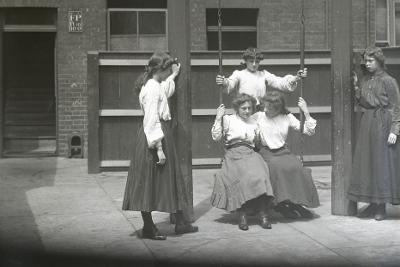
In an age when children still went down pits and up chimneys, and when trade unions were still feeling their way, Colman's introduced a series of welfare benefits for their workers that were far ahead of their time.
This is a statement from the Colman's-produced booklet on the history of the firm. The words are not untrue—but neither do they paint the full picture. Colman's did indeed introduce a vast range of welfare schemes, many of them truly pioneering, but workers at Colman's still experienced the inequality and exploitation characteristic of the industrial age.

During the Industrial Revolution and into the Victorian era, young people were recruited as cheap labour. Children as young as 10 were still commonly recorded on the Norwich labour market as late as 1910. At Colman's as elsewhere, women and children often performed monotonous, strenuous tasks in dangerous conditions. Meanwhile, early labour unions were, at best, subtly discouraged.

Despite this, Colman's employees really did enjoy a privileged status compared to workers elsewhere. In an article published in 1893, an industry magazine declared that the 3,000 Carrow employees were 'the most well-cared-for mass of operatives in the world'. And they really were looked after, from infant care to provision of coffins. Jeremiah James and Caroline Colman believed that the welfare of their employees from cradle to grave was the Colmans' moral responsibility as good and enterprising Christians. Such paternalistic welfare was part of the business ethic of other nonconformist industrialists besides the Colmans, including Titus Salt, the Cadburys, and the Lever brothers. The social schemes and philanthropy of these employers created a sense of community that bonded the workers to their companies and inspired lasting loyalty.

At Carrow, one way of bonding the workers and the company was a company magazine, which was edited and printed twice a year. The Carrow Magazine served as a primary platform for company publicity and promotion, information, entertainment, and details about activities and provisions for the workers.
View images of the October 1910 issue of the Carrow Works Magazine
Webpages in the Working at the Colman's section

Work

Care

Betterment
Objects in our collection
Browse our full collection to find a range of Colman's items and artefacts.
Archives and resources
Explore more about Colman's across a range of archives and online resources.


