

Care
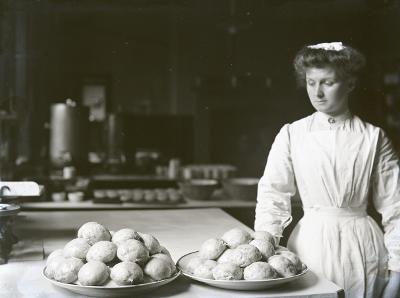
Colman's cradle-to-grave approach to welfare took care of almost all practical aspects of the Carrow workers' lives. Trowse Newton, one of Britain's industrial model villages, provided subsidised housing for many workers. Trowse included The Dell, a housing scheme built in a natural dell for the Carrow elderly. The company magazine proudly reported in 1908 on the building of two dozen alms houses there. The alms houses - cottages which were arranged in three rows around a manicured garden - were occupied by retired couples and widows of retired employees, along with one nurse.

A home for single girls provided safe and cheap accommodation for unmarried female workers in need of housing. This proved to be a refuge for many young women, some of whom had run away from their family homes. Those same young women, and others, had use of a launderette and were also able to participate in a clothing club where they could exchange, make and mend clothes.

A workers' canteen that opened in 1868 provided tea, coffee and hot meals at nominal cost, and its doors opened early to cater to the workers on the earliest shifts. This was many decades before workers' canteens became a norm.

Healthcare was provided by a company doctor and a nurse, who was one of the first industrial nurses in the country. Home visits to sick employees were initiated in 1878.

1899 saw the introduction of a pension scheme, one of several financial schemes offered by the firm. Other schemes included a Savings Club, also opened in 1899 and offering an interest rate of 4% to its members. Colman's Employees' Trust was established as part of the legacy of Jeremiah James Colman, who left £2,000 annually to the trust for a period of 20 years. The trust invited applications for financial assistance in times of need: for example, to help with acquiring appliances and clothing for children, and grants to enable recovery from illness. In 1918 the company inaugurated a pioneering scheme of annual leave.

The Colman's archive preserves one very poignant and peculiar object: the "coffin book", which contained records of the coffins provided for deceased employees or their family members. Names, ages, and relationships were recorded, along with the type of coffin to be provided, according to the individual's eligibility (employees of higher rank received more elaborate coffins). Deaths, births, retirements and, occasionally, other events in employees' lives, were announced in the workers' magazine.

Related webpages

Betterment


