
Gallery Title
Gallery Title
b/w printphotograph
Accession Number NWHRM : 6368.1.13
Description
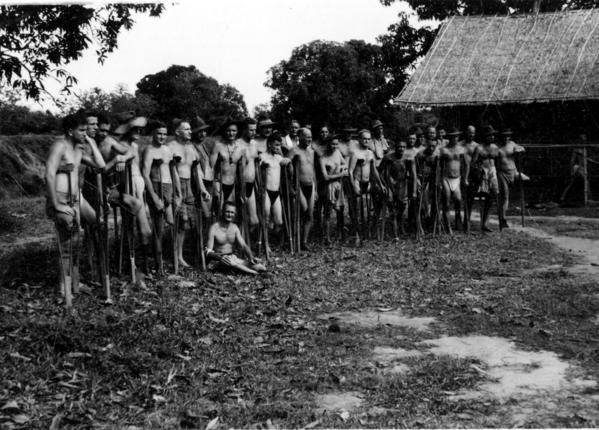
Photographic print (b/w); A photographic print showing a group of Far East Prisoners of War (FEPOWs) from the Royal Norfolk Regiment, 1945.
Read Moreb/w printphotograph
A photographic print showing a group of Far East Prisoners of War (FEPOWs) from the Royal Norfolk Regiment, 1945. Around 130,000 British, Australian, Indian and other Commonwealth soldiers were captured by the Japanese army following their demoralising defeats in the Malayan campaign of 1941-1942. In less than ten weeks, Japan conquered British-held territories across the Malay Peninsula, culminating in the fall of Singapore in February 1942.
Most international powers were bound by the Geneva Convention of 1929, which had laid out specific rules to ensure the fair treatment of Prisoners of War. However, while Japan had signed this treaty, it had never ratified it, so captured soldiers were frequently subjected to horrific treatment. Many were held in appalling conditions in Changi Prison on Singapore, while others were shipped to various parts of East Asia to perform forced labour in mines, shipyards and construction projects like the infamous 'Death Railway' from Siam (now Thailand) to Burma (now Myanmar). Tens of thousands died of exhaustion, mistreatment, malnutrition and disease.
Without proper resources or equipment, medical staff had to find extraordinarily resourceful ways to treat sick or injured prisoners. The men in this photograph all have amputated limbs, so their survival is a testament to this remarkable inventiveness - other images show them doing physiotherapy on wooden beams and even wearing prosthetic limbs. The photograph is part of a collection donated to the Royal Norfolk Regimental Museum by Lieutenant Colonel A.E. Knights.


