
Gallery Title
Gallery Title
shell case
Accession Number NWHRM : 3107
Description
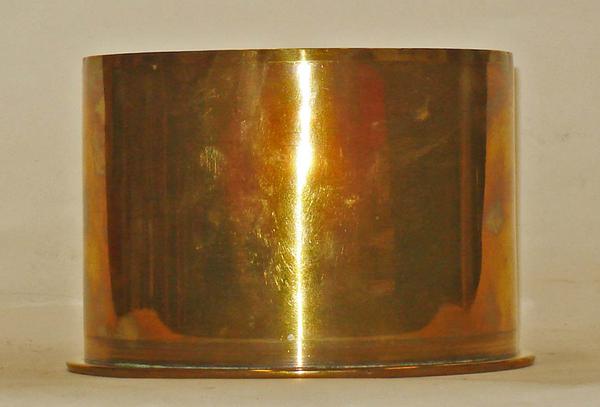
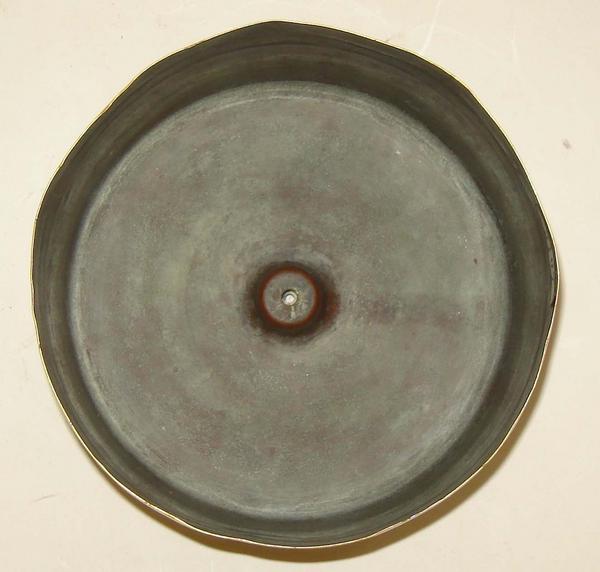
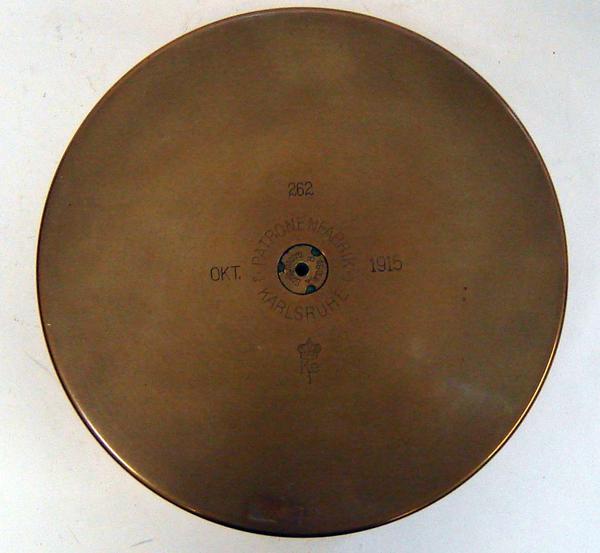
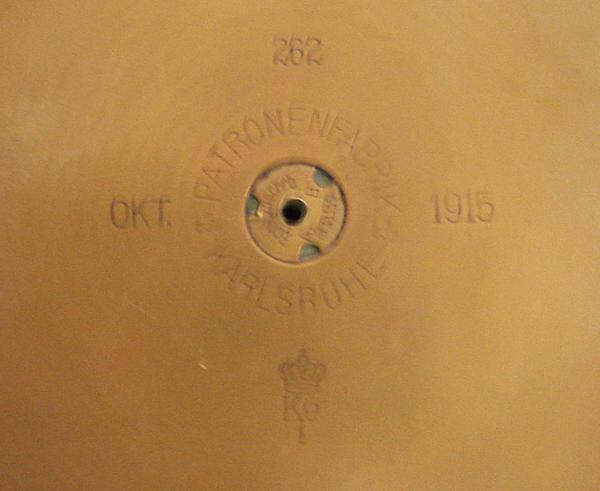
German 15cm brass shell case from El Arish, Redoubt, Gaza, used by the Turks as an alarm gong, captured 8th November 1917. Marked on base around the primer ‘262’ over PATRONENFABRIK KARLSRUHE’ over a crown over ‘Ke’ ‘1’. OKT to left, 1915 to right. Meaning the case was part of batch 262 made in October 1915 at the Royal shell factory, Karlsruhe on the River Rhine in Baden, Germany. In the centre of the base is the primer marked ‘Schlgzdschrb’ ‘A.B’ ‘FLSp’ for Schlagzundschraube – a screw-in percussion primer made by a company with the initials ‘FLSp’
Read Moreshell case
This brass cartridge case held the propellant for a German 15cm howitzer. It could contain up to seven bags of explosive and was loaded separately into the gun-breech behind the shell. This variable charge and firing angles up to 45 degrees, enabled the weapon to fire accurately over hills and obstacles, dropping shells onto shelters and into trenches.
After the depredations of the Balkan Wars early in the twentieth century, Turkey’s Army became dependent on Germany for money and munitions. Consequently, Turkish pattern weapons, made by Krupp and Mauser were augmented by similar German Army models. This shell case is for the German schwere Feldhaubitze (19)13, of 15cms calibre or five point nine inches, hence its British name ‘Five-Nine’. It fired a 42 kg shrapnel shell 8.5 km timed to burst in the air with a black cloud, hence another British nickname, ‘Jack Johnson’ after the African-American heavyweight boxer. The high explosive round could pierce half a metre of concrete and blast a crater one and a half metres deep and three metres wide.
The Turks were using this particular case as an alarm gong, common practice by all armies in the First World War to alert troops to sudden raids or gas attacks. It was captured 8th November, 1917 at El Arish redoubt where the 1/4th and 1/5th battalions of the Norfolk Regiment formed part of General Sir Edmund Allenby’s left wing at the third battle of Gaza. The first two battles, under different generals, had caused heavy casualties among the Norfolks.


